
What makes a good luxury travel website?

Most travel website advice is written for booking engines. Luxury operators rarely sell that way: the enquiry is the product, and buyers compare for weeks. What two luxury travel builds taught us about what the site actually has to do.
A good luxury travel website sells a feeling before it sells a product, and it usually has to do that without a booking engine, because for most luxury operators the enquiry is the product. Beyond that, the right build depends on one question: are you selling something bookable, like a transfer or a set experience, or something tailored, like a trip built around one client? Zenith Digital's two luxury travel builds sit on either side of that line, and they needed different websites.
This article covers the bookable-or-tailored split, four lessons drawn from both builds, and when a booking engine genuinely is the right answer.
TL;DR
- Decide first whether you sell bookable services or tailored trips. The site's structure, traffic source and final step all follow from that.
- The price sets the design brief. A buyer spending five figures notices anything that looks like a template.
- Know where the website's job ends. For tailored travel it ends at a well-briefed conversation with a person, not at a checkout.
Who this is for
Tour operators, destination specialists, chauffeur and transfer companies and private experience providers selling at the top of the market. If you sell high volumes of fixed-slot day tours, much of this still applies, but the section on booking engines matters most to you.
Bookable or tailored?
Luxury travel businesses sell one of two things, and some sell both. Getting this right before design starts is the single biggest decision in the build.
| Compare | Bookable | Tailored |
|---|---|---|
| Typical product | A private airport transfer or a set experience | A tailored multi-day trip |
| Our build | Bel'Istria | Scottish Luxury Experience |
| How the buyer shops | By service and place, often starting from search | By operator, comparing a shortlist over weeks |
| Traffic that mattered most | Organic search, one page per service | Paid campaigns matched to landing pages |
| Where the site ends | A booking flow | An enquiry that hands over to a person |
Lesson one: the price sets the design brief
Scottish Luxury Experience sells tailored trips across Scotland priced from £15k to £100k per journey. The constraint that shaped the whole build came from that price tag: a brand selling £100k journeys can't look mass-market anywhere. So the site uses cinematic imagery of Scotland, restrained type and unhurried pacing, and nothing that could read as a template. It was designed and built in four weeks. The full project is in the Scottish Luxury Experience case study.
The practical implication: budget for real photography before you budget for features. On a luxury travel site the imagery is the product demonstration, and stock photography of generic destinations is the fastest way to look like everyone else.
Lesson two: bookable services are searched by service and place
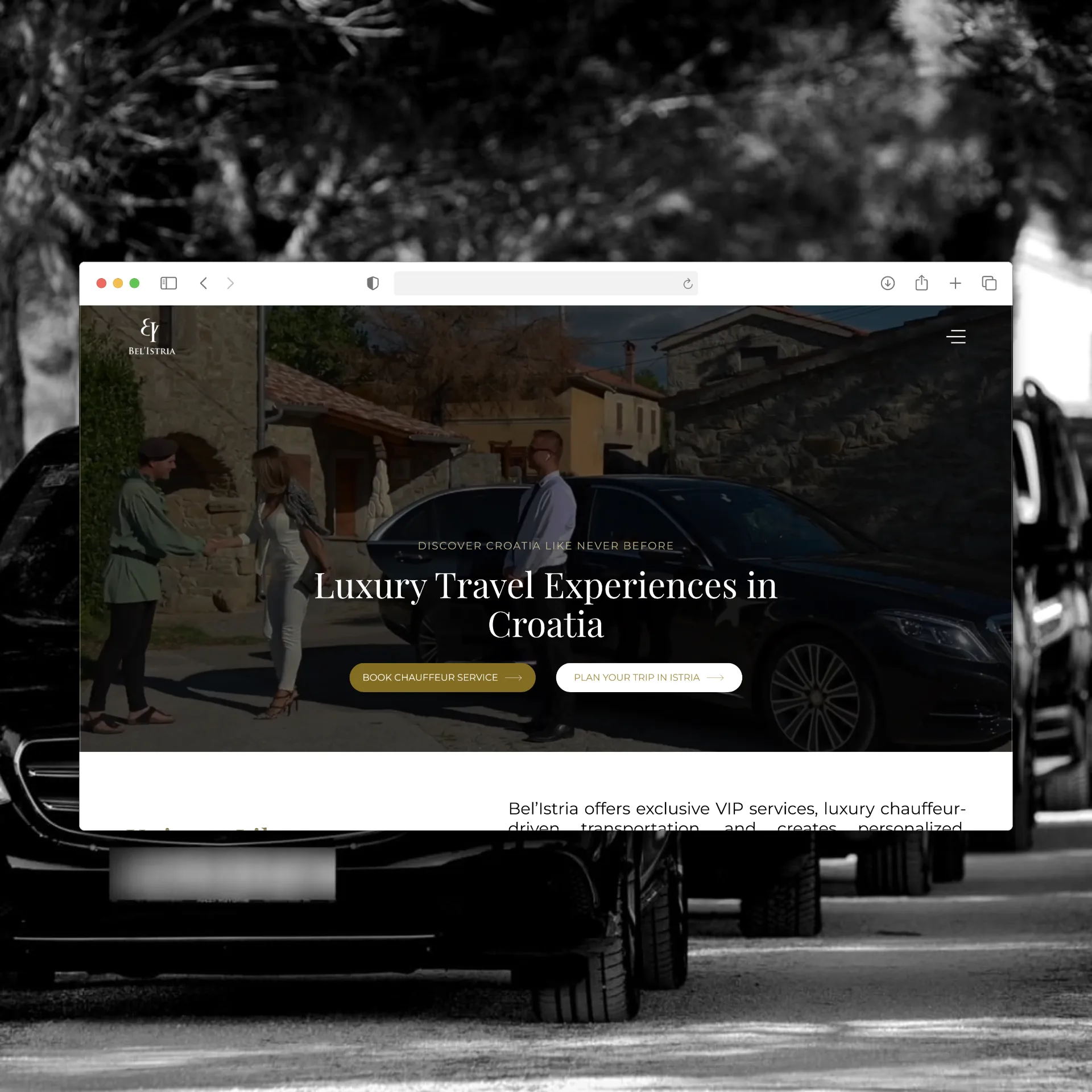
Nobody searches for a transfer company by name until they already know it. They search for the service in the place. Bel'Istria's old site asked a handful of pages to rank for everything. The rebuild gave each service cluster its own page: chauffeur services, airport transfers, hotel transfers, events and weddings, and exclusive experiences. Search impressions grew 257% year on year afterwards, led by terms the old site had never ranked for. The detail is in the Bel'Istria case study.
If you sell bookable services, one page per service and area is usually worth more than any design decision on the site.
Lesson three: know where the website's job ends
Nobody adds a £40k trip to a cart. On Scottish Luxury Experience, the enquiry flow gathers what the sales conversation needs and then hands the client to the founders for a call. The website's job ends where the human conversation should begin, and a site that tries to go further gets in the way.
Bel'Istria sits on the other side of the line. Transfers are bookable, so the site carries two booking flows, one for chauffeur services and one for private trips. And one thing was deliberately left out: a custom itinerary generator the project surfaced along the way. We scoped it and concluded it belonged off-site rather than forced into the website. Deciding what the site should not do is part of the build.
Lesson four: the website is one part of a system
Within seven months of launch, the growth system behind Scottish Luxury Experience had turned paid traffic into $521k of booked trips. That system was built with MOD Digital, who ran the strategy, advertising, CRM and proposals. Zenith Digital built the website that fronts it. The revenue belongs to the whole system, not to the site alone.
That is worth remembering whenever anyone credits a website alone for travel revenue. A luxury travel site does its job when it makes the ads worth clicking, the enquiry worth sending and the call worth taking. It rarely sells a five-figure trip by itself.
What both builds had in common
Mobile first, in practice: Bel'Istria's old site didn't work properly on phones, and travellers plan on phones. Both sites were built to work fully on a phone, not just to shrink onto one.
Speed for paid clicks: A landing page that loads slowly wastes the click the advertising paid for. Scottish Luxury Experience's pages are message-matched to the campaigns that feed them and built to load fast.
A site the team can grow: Bel'Istria runs on the Wix Studio CMS, so the operator adds services and pages without a developer, and the site has grown to more than 70 pages that way.
When is a booking engine the right answer?
When you sell high volumes of standardised products with fixed dates, times and prices: scheduled day tours, set-departure group trips, fixed-price transfers on known routes. There a real booking engine with live availability earns its cost. For tailored trips where every itinerary is different, a booking engine forces a one-off product into a fixed shape and usually loses the sale it was meant to speed up. Many operators need both, a booking flow for the bookable services and an enquiry route for everything else.
Running a luxury travel business?
Tell us whether you sell bookable services, tailored trips or both, and we will tell you honestly what the website needs to do, and what it doesn't.
The takeaway
Decide bookable or tailored first, let the price set the design brief, give each service its own page if people search for it, and stop the website where the conversation should start. If your site gets visitors but few enquiries, why a website gets traffic but no enquiries goes deeper on the comparison buyers make. If you are weighing the platform, whether Wix Studio is good enough for a premium brand covers its limits honestly, and our Wix Studio website design service covers the build.
Want this done on your own site?
We build and move websites on Wix Studio, and build custom when you outgrow it. Tell us what you're working with.
Questionspeople ask
If yours isn't here, ask it on a call. We answer in plain terms.
A luxury travel website needs real photography rather than stock, a page for each service or trip type buyers search for, specific detail that answers the questions buyers would otherwise phone to ask, and an enquiry flow that gathers what the sales conversation needs. Bookable services also need a booking flow.
Only for products that are genuinely bookable, such as fixed-price transfers or set-departure experiences. Tailored multi-day trips sell better through an enquiry that hands over to a person, because every itinerary is different. Many luxury operators need a booking flow for some services and an enquiry route for the rest.
Yes for most travel operators. Zenith Digital's Scottish Luxury Experience and Bel'Istria builds both run on Wix Studio, and Bel'Istria has grown to more than 70 pages on its CMS. Heavy custom tools, such as an itinerary generator, are better built separately and linked from the site.
By making the site win the comparison buyers make over several visits: pages specific to each service or trip, proof and imagery that match the price, and an enquiry that asks the right questions without asking too much. For bookable services, one page per service and area helps people find you in search.
A free audit that actually tells you something
Drop your site in and we'll review it by hand, then send a short video walkthrough of the highest-impact fixes. No auto-generated PDF, no obligation.
Someone opens your site and records what they find. No automated score, no templated PDF with your logo dropped into it.
Conversion leaks, search and AI visibility, speed, design and trust, copy and positioning, and the order we would fix them in.
You get the walkthrough whether or not we ever work together. No pitch, no obligation, and it lands within 2 business days.
Sample site audit
62/100
18 issues foundPerformance score
Top findings
- Largest Contentful Paint over 4s
- Missing meta descriptions on 9 pages
- No structured data for search
Keep reading
More on the same thing, or the next thing worth knowing.
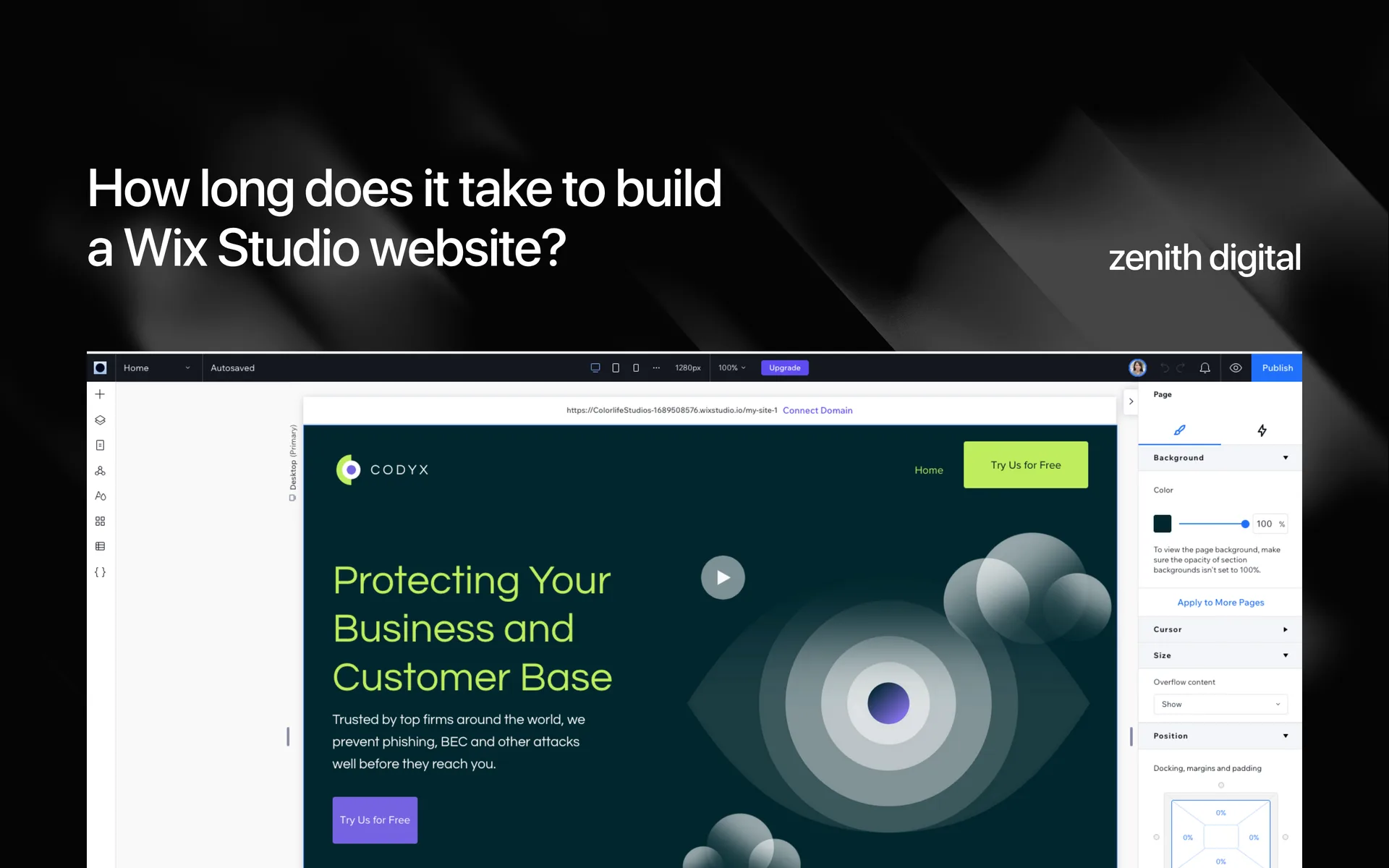
How long does it take to build a Wix Studio website?
Two to five weeks for most professionally built Wix Studio sites, and the build itself is rarely what decides the date. Content readiness and decision speed do. Here is the honest timeline, with real projects attached.
Read the post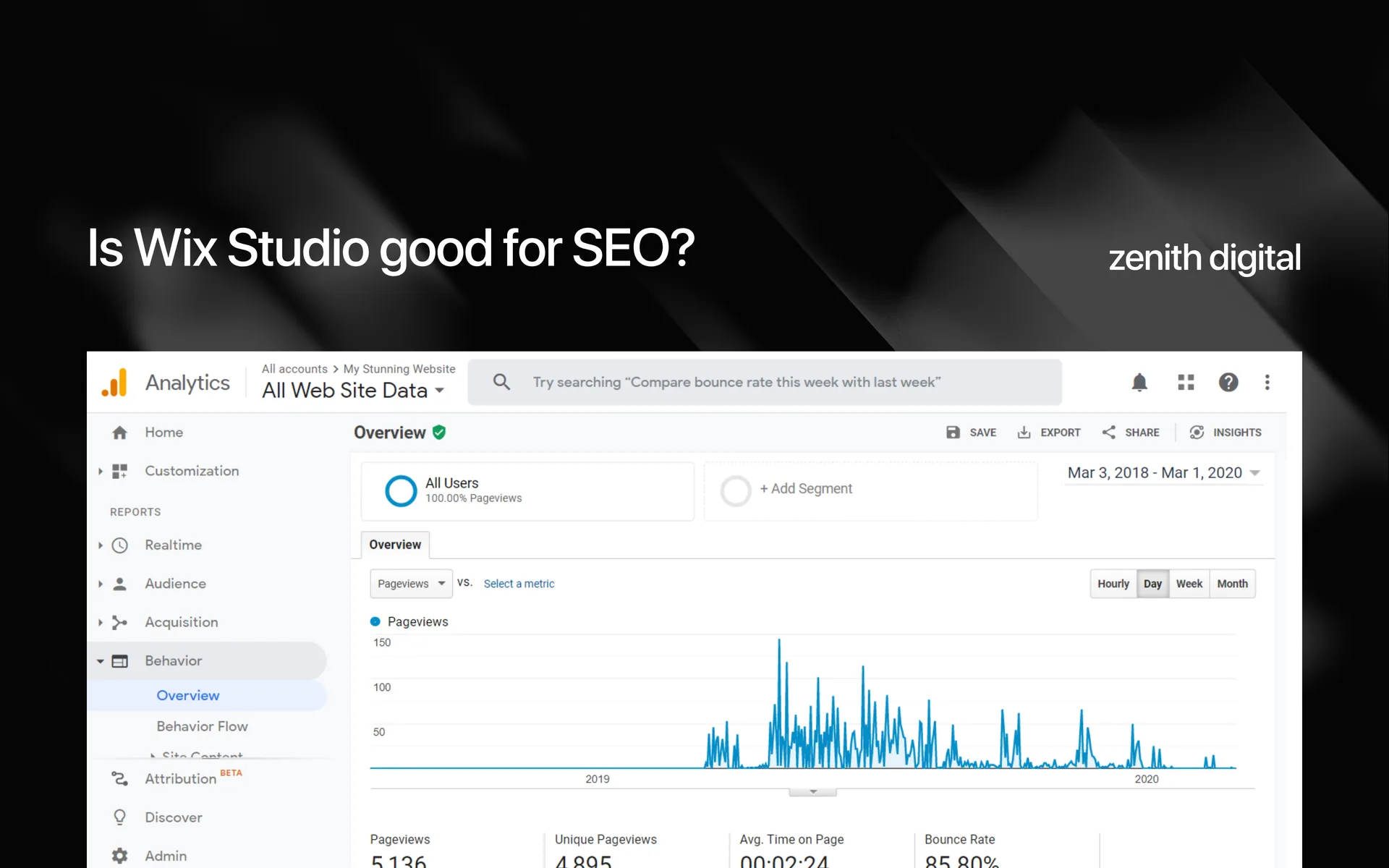
Is Wix Studio good for SEO?
Yes, and the platform stopped being the interesting part of that answer years ago. What decides whether a Wix Studio site ranks is its structure, its content and its proof, and those are yours to get right or wrong.
Read the postSources
Primary documentation behind the claims above, so you can check them rather than take our word for it.
Zenith Digital: Scottish Luxury Experience case study
Trip prices, four-week build, and $521k revenue attributed to the full MOD Digital and Zenith Digital system. As published.
Zenith Digital: Bel'Istria case study
Service-cluster architecture, booking flows and 257% year-on-year impression growth. As published.